Mount an angled mirror above the range
The single most-repeated recommendation across wheelchair-cooking sources is a mirror. From a seated position you cannot see into the top of a pot on a standard stove — you're looking up at its side. That means you can't see whether water is boiling, whether sauce is scorching, or whether food is close to done without leaning across a hot burner.
A mirror mounted on the wall or the range hood above the stove, angled downward, gives you a bird's-eye view. Living Spinal describes it as "prevents reaching across an open flame or hot electric coil." Enabling Devices calls it "one of the most valuable hacks a wheelchair-using cook can install."
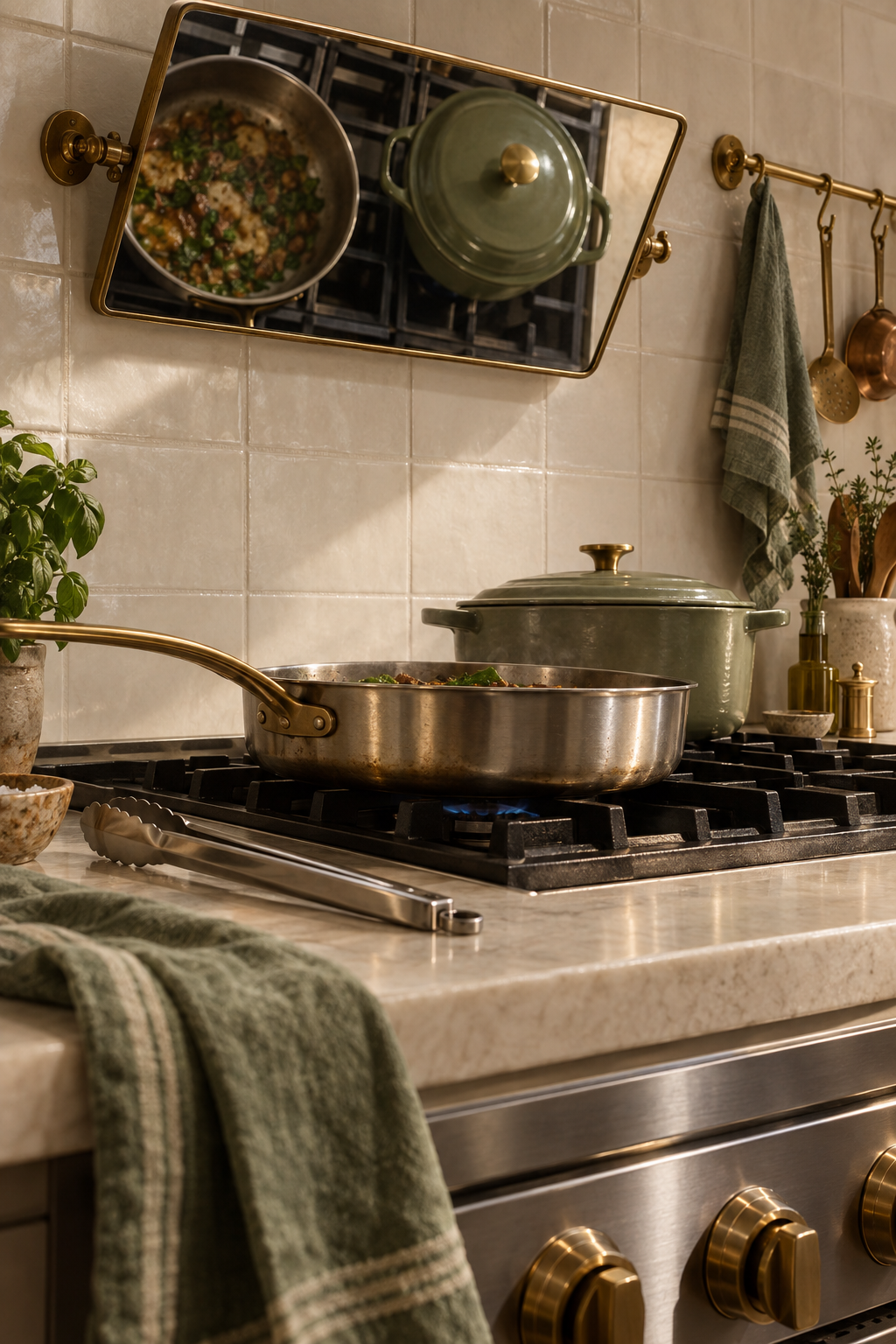
Any medicine-cabinet-style tilting shaving mirror works. Look for one with a swing arm so you can angle it to the burner you're using. Mount it behind the range, out of direct heat, roughly 12–18" above the burners.
Use the front burner. Always.
If your stove has four burners, one of them is closer to you. Cook on that one. Urban Cripple puts it directly: reaching past a hot front burner to work on a back burner is how wheelchair users get burned. If you must use a back burner, move whatever is on the front burner off the heat first.
Corollary: buy one really good pan that fits your front burner. A 10–12 inch stainless sauté pan handles most of home cooking — stir-fry, braise, sauce, sear, one-pan dinners. Treat it as your default surface.
Pot handles: away from your lap, off the burner next to it
Two competing forces: a handle sticking out into the room can catch on a wheelchair armrest or clothing. A handle pointing over an adjacent hot burner gets hot itself. The rule taught in accessible-cooking curricula:
- Turn the pot handle so it points to the 2 o'clock position from your seated view — off the front, off an active burner, but not straight toward you.
- Never leave a handle pointing straight at your chest.
- If you use a wok or a saucepan with a long straight handle, angle it toward the wall side of the stove.
If you have to reach past the front burner
Sometimes there's no avoiding it. Urban Cripple's protocol, adapted here:
- Move the front-burner pan off the heat first. Onto a trivet on the counter or your cart.
- Roll up your sleeves. Loose cotton catches fire fast.
- Sit up tall and scoot forward in the seat to maximize your reach height.
- Reach around the burners, not over them. Come at the back pot from the side.
- Use a high-rim pan so you can stir and see without leaning directly over.
- Take the pan off the heat when you need to see clearly. It's five seconds.
From Urban Cripple: "Use safety glasses when working with sugar or frying because the face may be only inches away from the substance." Splatter that a standing cook catches on their apron catches a seated cook on the face. Cheap kitchen safety glasses live on a hook next to the stove.
Long tongs are how you reach back-of-stove knobs
Almost every American range built before the last decade has knobs on the back panel. Urban Cripple's fix, endorsed by others: a long pair of kitchen tongs — 12 inches or more — gripped closed, becomes an extension of your arm for turning knobs and pressing back-panel buttons without reaching across burners.
If you're stove shopping (or a landlord is): front-mounted knobs are the single biggest accessibility improvement in a range. Every major manufacturer now offers front-knob models — GE Café, Bosch, Samsung, Whirlpool. Add "front controls" to your search filter.
Why induction changes everything
If you can replace anything in the kitchen, replace the range with induction — or add a portable induction burner ($60–$150) that sits on any counter or rolling cart. From Enabling Devices: "an induction stovetop is a good option because its surface does not get hot." It's not a small improvement — it fundamentally changes the risk profile:
- The cooktop stays cool. Only the pan heats. Spilled food doesn't scorch onto the surface. Brushing a hand across the stove is not a burn event.
- Instant on, instant off. No coil retaining heat for 10 minutes after you turn it off.
- Faster. Water boils in half the time, so you spend less time near the heat.
- Automatic shutoff when the pan is removed — critical if you get called away mid-cook.
- Works on any counter or rolling cart — you can move the cooking surface to a height that works for you.
Requires magnetic cookware. Cast iron and most stainless steel qualify; aluminum and copper do not (a magnet sticks = it works).
The oven: side-hinged doors, or a wall oven you can approach from the side
A standard range oven with a drop-down door is the hardest thing in the kitchen to use from a chair — the open door blocks your approach, and you're reaching over it into a hot cavity. The ADA §804.6.5 calls for side-hinged oven doors with a work surface next to the latch side.
- Best case: a wall oven with a side-hinged door, mounted so the interior floor of the oven is roughly at your chair-arm height. Whirlpool, GE Café, and several European brands make these.
- Working with what you have: if your oven is a drop-down door under the range, use it primarily for things that don't need mid-cook attention — casseroles, braises, roasts. Use a toaster oven or countertop convection oven at cart height for anything requiring frequent checks (cookies, roasted vegetables, reheating).
- Sliding oven racks ($20 aftermarket) let you pull the rack out without reaching into the cavity. Combined with long silicone oven mitts that protect the whole forearm, they cut the risk of oven burns dramatically.
Transporting hot things from stove to sink or counter
This is where a lot of injuries happen. A pot of pasta water weighs 8–10 pounds, is 212°F, and needs to travel from the stove to the sink. You cannot carry it across your lap.
- Roll a cart to the stove first. Transfer the pot from stove to cart, roll cart to sink, transfer from cart to sink. Never make the trip with the pot on your lap.
- Drain in place. A pasta insert or a pot-sized colander that drops into your existing pot means you lift the drained pasta out — the hot water stays in the pot until it cools.
- Use a ladle-and-transfer method: leave the pot on the stove and ladle hot contents into a serving bowl on the cart. Slower, safer.
- Long silicone oven mitts that cover the forearm up to the elbow are essential — regular oven mitts stop at the wrist, exactly where hot pot rims can graze.
- Angled mirror mounted above the range
- One 10–12" pan sized to the front burner
- 12"+ tongs kept next to the stove for back knobs
- Long forearm-length silicone oven mitts
- Rolling cart parked adjacent to stove during cooking
- Kitchen safety glasses on a hook near the range
- Considered: portable induction burner as a starting upgrade
Continue → Prep & reach techniques